How to Choose the Right Grain Dryer for Your Business?
Choosing the right Grain Dryer is a practical decision about quality, energy, and risk. It affects every load that enters your facility.
The Food and Agriculture Organization’s The State of Food and Agriculture 2019 estimates that 14% of food is lost between harvest and retail. Grain handling deserves serious attention. Moisture, temperature, airflow, and holding time can change the result inside one season. A 25% moisture corn load may require more drying energy, longer operating hours, and tighter quality control. A small mistake can become expensive.
Dr. John A. Wilcke, a respected grain-drying specialist from the University of Minnesota, states, “The goal of drying is to remove enough moisture to prevent spoilage.” That principle remains useful, although real farms are rarely so simple. USDA grain quality guidance connects safe storage with moisture control, while ASABE engineering standards support consistent dryer performance testing. FAO’s loss data also shows why post-harvest efficiency matters beyond the farm gate.
The best Grain Dryer is not always the largest or cheapest model. Compare expected throughput, fuel source, airflow design, drying temperature, automation, maintenance access, and final moisture uniformity. Continuous-flow systems may suit large commercial operations. Batch or mixed-flow designs can offer greater flexibility for smaller facilities.
Look closely at your wettest harvest days. That is where the equipment proves itself.
Cost calculations should include fuel, labor, downtime, grain shrink, and future expansion. Some assumptions will be wrong. Recheck them using local weather records, crop moisture data, and supplier performance tests before making the final purchase.
Define Moisture Targets: 15% Corn, 13% Wheat, and 13% Soybeans
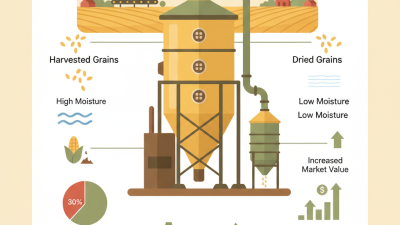
Choosing the right grain dryer starts with a clear moisture target. For many operations, corn is dried to about 15%, while wheat and soybeans often leave the dryer near 13%. These figures support safer storage and reduce spoilage risk when grain is cooled and monitored properly.
Corn can tolerate a different drying approach than wheat. Its kernels are larger and may require steady airflow to limit stress cracks. Wheat benefits from even heat, especially when intended for milling. Soybeans need careful handling because excessive heat can damage seed quality and reduce germination. It sounds simple. It is not.
Measure moisture at several points, not only at the dryer outlet. A handheld meter can show variation between the surface and the grain core. I have seen loads that appeared ready at 15% but gained moisture during cooling. That result exposed a weak sampling routine, not necessarily a faulty dryer. Choose equipment with adjustable temperature, controlled airflow, and reliable discharge monitoring. Capacity must also match harvest speed, or wet grain may wait too long in storage. These targets are practical guides, not universal rules. Local humidity, storage time, grain condition, and end use may require adjustment. A processor may demand tighter limits, while short-term storage could allow a different operating range. Keep written readings for each batch and review them before changing settings.
How to Choose the Right Grain Dryer for Your Business?
Define Moisture Targets: 15% Corn, 13% Wheat, and 13% Soybeans
Target moisture levels help determine dryer capacity, energy requirements, and operating time.
A common commercial guideline is approximately 15% for corn and 13% for wheat and soybeans
before storage, although final targets should be adjusted for storage duration, temperature,
grain quality, and local standards.
Measure Efficiency with BTU per Point of Moisture Removed
How to Choose the Right Grain Dryer for Your Business?
BTU per point of moisture removed is a practical way to compare dryer efficiency. It measures the heat required to remove one percentage point of moisture from a defined grain quantity. Lower BTU values usually indicate better fuel performance. However, compare figures only under similar grain, weather, airflow, and operating conditions.
Record the starting moisture, final moisture, grain weight, fuel use, and drying time. For example, drying 10,000 bushels from 20% to 15% removes five moisture points. Divide the total fuel BTUs by 50,000 bushel-points. The result shows BTU per bushel-point. Keep a notebook near the control panel. Small details matter. A blocked screen, wet grain, or excessive exhaust heat can distort the result.
Do not trust one reading completely. Weigh grain before and after drying when possible, and check moisture with a calibrated meter. Ambient temperature also changes performance. A dryer may use more energy on a cold, windy night than during a mild afternoon. Review several loads before choosing equipment. A higher-capacity unit may appear efficient while operating below its ideal load. That is easy to miss. Also examine cooling energy, maintenance access, and moisture uniformity. Fuel savings mean little if grain leaves the dryer unevenly dry or suffers quality loss. Efficiency is useful, but it needs context.
Protect Grain Quality by Managing Airflow and Drying Temperatures below 180°F
How to Choose the Right Grain Dryer for Your Business?
Protecting grain quality begins with controlled airflow and drying temperatures below 180°F. A dryer should move air evenly through every layer, not only the warmest areas. Uneven airflow can leave wet pockets inside the grain mass. Those pockets may develop mold during storage. Check fan capacity, duct design, and plenum pressure before choosing equipment. Your crop, moisture level, and intended market also affect the safest operating temperature.
Tips:
Measure moisture at several points, not just near the outlet. Keep screens and ducts clean. Watch for hot spots, unusual odors, or changing fan sounds. Record air temperature, grain temperature, airflow settings, and drying time. A simple log can reveal problems before quality declines. Do not rely on one moisture reading.
In practical use, gentler drying often protects test weight, germination, and appearance. However, slower drying may increase energy use and handling time. The ideal setting is not universal. Follow crop-specific guidance from qualified agricultural experts and the dryer’s technical manual. Keep drying air below 180°F, while confirming the actual grain temperature remains suitable for its final use. I have learned that a stable airflow pattern matters as much as heat. A powerful fan cannot correct poor loading or blocked passages. Sometimes, reducing the batch size works better than increasing temperature. Test small adjustments, record the results, and question settings that seem convenient but lack evidence.